

Arborek island has many different species of Nudibranch on its house reefs.

Relax with a nice cold beer in comfy beanbags or hammock, and watch the sunset.

Crystal clear waters off the basecamp...These amazingly clear waters make visibility when diving perfect, allowing you to never miss a thing.
I actually did my first ever dive whilst on a coral reef conservation project, and I’ve been hooked ever since! Waking up every morning to go diving in crystal blue waters was just incredible. I made such fantastic friends with the other guys on the team!
Raja Ampat
Raja Ampat loosely translates to mean "Four Kings", and is an archipelago in the East of Indonesia made up of 1500 small islands and cays surrounding the main four islands (or Four Kings) of Misool, Salawati, Batanta and Waigeo. The Raja Ampat Regency covers over 40,000 Sq Km of land and sea, including the largest national marine reserve in Indonesia; "Cenderawasih Bay". The Regency is part of the new West Papua province which was formerly know as Irian Jaya. The capital of the regency is Waisai (est. population 6000) which is located on Waigeo and is only a 45 minute boat ride from our island/project site.

Raja Ampat sits right in the heart of the "Coral Triangle", which is unquestionably the most bio-diverse area for marine life in the world.
Incredibly, the oceans that surround Raja Ampat contain 80% of all the world's coral species (10 times the number of species found in the entire Caribbean!), 1350 species of fish, 6 of the world's 7 marine turtle species and 27 varieties of marine mammal.
With so many of the 1500 small islands, cays and reefs still to be mapped and discovered, Raja Ampat truly is one of the "worlds" final diving frontiers!

Project Summary & Goals
Summary:
Barefoot Conservation is working in partnership with the Raja Ampat local government, local Papuan Communities and stakeholders, to protect the coral reefs of Raja Ampat and the communities that rely on them.
This partnership is bonded by a willingness to make a real difference, and the understanding that research, survey dives and Marine Protected Areas cannot work unless accompanied by education and the sustained alleviation of poverty.
The Raja Ampat project is designed to work at a grass roots level, thus making a real difference to real people, and a difference that each volunteer can see and be a part of.
Goals:
- To conduct marine underwater surveys using the Reef Check methodology, collecting data, for the use in advising local government, local communities and other NGO partners, on the health of coral reefs and the marine life in Raja Ampats Marine Protected Areas (MPA's).
- Produce a local Manta Ray Identification (ID) database, through underwater manta ray surveys. Sharing collected data with local government and NGO partners.
- Monitor the number of Crown of Thorns Starfish (COT's) in the region, undertaking COTs survey/removal dives during large outbreaks.
- Undertake educational programmes on environmental issues, sustainable fishing techniques (if necessary) and the economic benefits of MPA's.
- Increase quality of life and alleviate poverty in local communities, through our community projects - Education, Waste Management, Health Clinics, Family Planning, Dental Hygiene and Renewable Energy.
- Encourage entrepreneurial attitudes to deter from unsustainable destructive activities like shark finning or dynamite fishing.
Insurance
You will need both scuba diving and travel insurance that covers you for the duration of your expedition and for scuba diving up to 30 meters. IF YOU DO NOT HAVE ADEQUATE SCUBA DIVING INSURANCE YOU WILL NOT BE ALLOWED ON THE EXPEDITION. You must send us copies of your insurance certificates and policies before you join the expedition.
We strongly recommend you use Divers Alert Network (DAN) for your insurance as they are by far the best and most reasonably priced. Please visit www.diversalertnetwork.org for further details.
Visas, Passport & Vaccinations
Most nationalities will need a Visa when entering Indonesia. Please note in most cases a Visa On Arrival (VOA) can be obtained at the airport for US$35 (approximately £21, $37 AUD) or can be purchased before departure. The VOA is for a total duration of 30 days only and can only be extended once in country, for another 30 days (approximate cost £35, US$58 or AUD$62). If you are joining an expedition for more than 8 weeks we recommend you purchase a 60 day social visa from the Indonesian embassy in your country before joining the expedition. Please contact one of our helpful trip advisers before applying for this visa, as we can provide you with all necessary forms, documents and information to process the application.
You can now also apply for a eVOA online before arrival, via this official Indonesian immigration website: https://molina.imigrasi.go.id/
You MUST have 6 months validity left on your passport when entering Indonesia.
For vaccinations it is important that you consult with your local physician 4-8 weeks before joining the expedition. This is so you can get up-to-date information on vaccinations and general health concerns when travelling to East Indonesia.
While the site does not generally have a major issue with mosquito's (due to the beach front location and cool breeze), we still recommend you take precautions against Malaria. However we do not recommend you take Lariam (mefloquine) tablets as these can have side effects that could be mistaken for Decompression Sickness.
Please remember you are travelling to a remote tropical island in a remote part of the world. As Indonesia is a tropical country the risk of tropical virus's is higher, than in other countries.
In all cases please consult your local physician for up-to-date medication advice.
Getting There
The main airport used to get to Raja Ampat is "Sorong" on the western tip of Papua, this area is extremely safe, is very well built up and set up for tourism. The best way to get to Sorong is:-
"Jakarta to Sorong to Raja Ampat"
You can fly from Jakarta, the capital of Indonesia to Sorong . As all internal flight to Sorong leave early morning we recommend you look for flights that arrive in Jakarta around late evening (7pm) the day before your expedition start date. This way you will spend less time in transit at Jakarta airport. Operators that fly to Sorong from Jakarta are: AirAsia, Lion Air, Batik Air, Sriwijaya and Garuda Air. (all have stopovers in either Makassar, Ambon or Manado, accept AirAsia and Batik Air which are the only airlines to currently fly direct). We recommend using the flight booking site Skyscanner, and highly recommend arriving the day before your expedition start date if possible.
The meeting point on your expedition start date is the Fave hotel which is very close to the airport (5 minute taxi ride) where you can relax in the hotel lobby or restaurant while you wait for the 9am ferry to depart for Waisai the capital of Raja Ampat. A Barefoot representative will collect you from the Fave Hotel at 08:00 to take you to the ferry port, where your catch the ferry (approx 2 hours) to Waisai. Our boat will meet you on arrival in Waisai and take you on the final 90 minute boat ride to your home for the duration of your expedition. NOTE: If you are already travelling in Indonesia before your expedition or travelling in Singapore please contact us for alternative ways to get to Sorong if you do not wish to fly from Jakarta.
“Raja Ampat to Sorong to Jakarta”
On the day of your departure from the expedition, our boat will depart basecamp at 07:15 to take you back to Waisai, where the ferry to Sorong leaves at 9am. You will arrive in Sorong approx 2.5 hours later, around 11:30am, and may need to stay one night in a hotel in Sorong as there are limited flights departing Sorong airport in the afternoon. Most flights from Sorong to Jakarta leave in the morning/early afternoon and arrive in Jakarta late morning/midday. From here you can transfer from the domestic terminal to the international terminal to wait for your connecting international flight home.
**Barefoot Conservation can help advise you on domestic flights to/from Sorong**
Barefoot Conservation can also advise you on international flight bookings, so please do not hesitate to contact us when booking flights.
Expedition Staff
Our expedition staff are made up of both overseas volunteers and paid local community members. The staff are there for your health & safety and to help guide you in getting the best possible experience from your time with us. At Barefoot Conservation we feel it is very important we all work together as a team to achieve our goals, and that mutual respect is shown to each other at all time. No matter what your age or experience in life, everyone's opinions are valid and listened to by our dedicated staff members, so please never feel afraid to discuss any issues/concerns or opinions with our expedition staff.
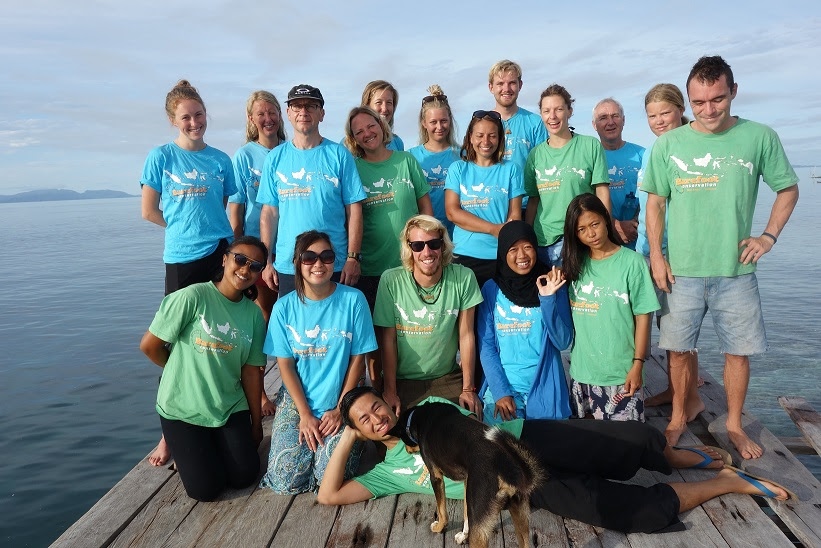
Expedition Staff :
- Project Site Manager/Expedition Leader (PSM/EL)In charge of managing all on site personnel and holds overall responsibility for managing the expedition, including the smooth running of the day-to-day activities and ensuring key targets/goals are met.
- Project Scientist (PS)Responsible for designing, planning and co-ordinating the science programmes. Communicating all science related data to local government, project partners and local community. In charge of all SO's and deputises for the EL when needed.
- Scuba Instructor (SI)Responsible for teaching all PADI Scuba courses to volunteers and staff. Planning, organising and overseeing all day-to-day diving activates, including all diving related health & safety.
- Medical Officer (MO)Has the overall responsibility of providing medical support to all on-site personnel. Maintaining all medical equipment and supplies. Please note it is not always possible to have a MO on site, however during this time there is a local nurse on the island, we have doctors available to call, and the local hospital is 45 minutes away by fast speed boat. When possible we always try to have a MO on site, but there may be times when a MO is not on the project.
- Science Officer (SO)Works under the supervision of the PS and has the responsibility of running the science programme on a day-to-day basis, including presentations and in-water spot dives. Ensures all survey dives are well planned, run smoothly and that all the daily data is collated correctly.
- Community Officer (CO)Liaises between the expedition team and the local community. Responsible for co-ordinating the days community projects for volunteers and reports directly to the Country Manager and EL.
- Boat Captain (BC)Responsible for driving the boat safely to/from survey dive sites. Maintains and services the boat/engine, and oversees all personnel safety while on the boat.
- Dive Guide (DG)Works with the BC and SO to determine which survey sites to visit that day. Provides guidance and advice on the boat and is responsible (along with the BC) for the survey teams safety.
- Master Chef (MC)Responsible for providing amazing meals every day (except Sundays), which keep the expedition team going and full of energy.
Accommodation & Food
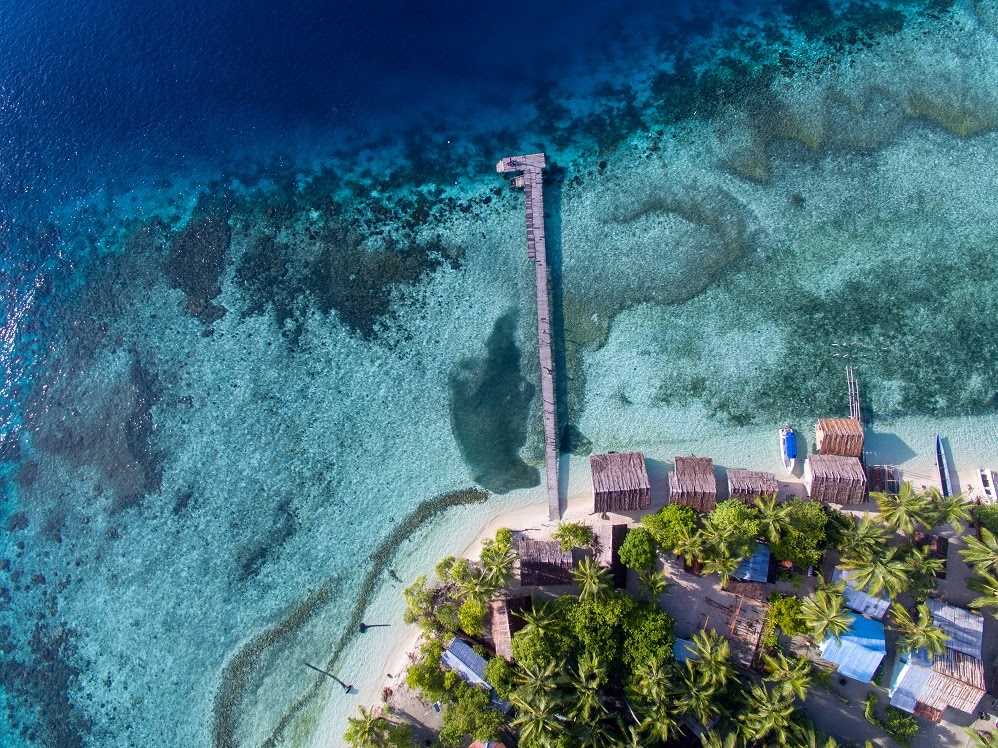
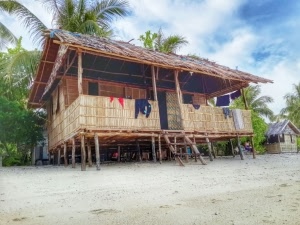
Accommodation is provided on our amazing beach-front location on Arborek Island, just meters from the calm, crystal clear ocean and comprises basic dormitory style beach bungalows, and two private beach bungalows (extra rental cost applies).

Each bungalow has been hand built by the local community using traditional methods and materials. You will be provided with a bunk bed, mattress, pillow, basic linen (you may wish to bring a light sleeping bag) and mosquito net, along with a fan for each room. The bungalows are same gender and have power supply so you can recharge cameras, tablets and phones.

**Please note accommodation is in basic shared beach bungalows, and is not of a 5 star luxury resort!**
The project site has western style toilets and limited fresh water to shower/wash in. While the island does have water wells, these are now getting increasing salty, so currently our fresh water comes from our desalination machine or from Waisai each Wednesday, while we find a solution to the communities/islands fresh water supply issue. Due to this and because we are a conservation project on a tropical island so we may at times limit the amount of shower time.
We provide 3 meals a day (specific dietary needs can catered for). These meals are at fixed times during the day, so that the day's dive surveying and community projects can be effectively managed. Meals are based upon local cuisine and seasonal availability of locally produced food. Meals are prepared and cooked by local staff, except on Sundays when expedition staff & volunteers will prepare and cook all meals.
While we will endeavor to provide a balanced diet of fresh fruit and vegetables during your expedition, you may wish to consider bringing a supply of vitamin supplements.
Volunteers with specific dietary requirements will be catered for, please indicate these requirements on your booking form.
Communications
At present only one local network provider (Telkomsel) has coverage/reception in the Raja Ampat region. If you really do want to stay in touch with the outside world, it is possible to purchase a Telkomsel SIM card (Jakarta Airport or Sorong city) and use it in your mobile phone while on site *YOU MUST REGISTER YOUR PHONE ON ARRIVAL AT JAKARTA AIRPORT*. The basecamp on Arborek has pretty good reception now as a new mobile tower was recently built on the island. Some overseas mobile phones may work if set to roaming but please check with your network service provider before joining the expedition. Calls/texts may well be cheaper from a local SIM card.
Smartphones can receive 3G/4G for use with internet, and our staff can help you purchase phone credit and data packages.
No mobile phones are permitted during Scuba/Science lectures or while attending any community projects.
Day-to-Day Expedition Life
Your typical day will consist of 2 survey dives and time spent on various community projects in the local community. At Barefoot Conservation we believe it is vital to work in the community, educating, improving equality of life and alleviating poverty, alongside producing a detailed habit map of the surrounding coral reef/marine life that the community rely so heavily on.
Breakfast will be served at 7am and depending on the weather, and advice from our local dive guides/boat crew, you will either start your first survey dive of the day at 9am or visit the local community to assist on various community projects which the Community Officer will organise.
At the end of each survey dive you will relay the data from your dive slates on to the data recording sheets, for later entry into our database.
After lunch (12:00-12:30) you will do the opposite of what you did in the morning, so if you worked on community projects in the morning, your undertake survey dives in the afternoon and vice versa.
Dinner is served at 19:00 and, after a short de-brief session on the days activities, the evening is yours to relax, have a cold beer and talk about the amazing marine life you saw or the kind villagers you made friends with, while watching the sunset off Barefoot jetty.

Some evenings may involve an advanced presentation or Indonesian language lessons for those interested and theory sessions for volunteers taking extra PADI scuba courses.
Monday to Friday are reserved for survey dives and Community project work.
Saturday is for fun dives where the Barefoot dive profiles are relaxed slightly, and dive computers can be used for multi-level divers, that are deeper and longer.
Wednesday mornings the team goes to Waisai the capital of Raja Ampat to collect/drop off volunteers and pick up supplies. Volunteers can join this trip to use the internet and buy any extra luxury items in Waisai. Please be aware that the capital only has a population of 6000 and hence is still small, so it does not have hundreds of shops.
Sunday is a complete NO dive day, this is for health & safety reasons and gives your body time to recover from the weeks diving. This gives you some valuable downtime when you can sunbath, play volleyball or football, go for a swim/snorkel, read a book, go for a walk around the island, watch a movie or visit the local village.
Saturdays & Sundays may be used by the SI when teaching extra PADI Scuba courses, however only confined diving (no deeper than 5 meters) can be undertaken on the Sunday.
NOTE* The above typical day is open to flexibility; the day may not always be as above due to logistical reasons or situations out of our control (bad weather, public holidays, local community ceremonies etc..). The morning survey dives may be at a far away dive site and thus breakfast may be served earlier. Or the local village may be off limits for the day due to private religious ceremonies. When ever possible Barefoot will try to stick to the typical day plan, however a certain amount of flexibility and understanding is needed from all expedition personnel.
Scuba Diving
Unqualified Scuba Divers:
If you join an expedition as an unqualified diver you will take part in the Dive Training Program (DTP) and be a Dive Trainee (DT). This will take part during the first week of the expedition and will involve being trained first as a PADI Open water (OW) diver, and then as a PADI Advanced Open Water (AOW) diver. Our fully qualified PADI Scuba Instructor will guide you through the dive theory, then confined water sessions (no deeper than 5 meters), and then, once you are comfortable, on to the open water sessions where your dive to no deeper than 18 meters.
The AOW course does not involve as much theory work as the OW course, and is more about reinforcing what you have already learnt, by undertaking 5 dives. A "Deep" dive (max 30 meters) and a "Navigational" dive are mandatory as part of the PADI AOW course, however, as you will be doing coral reef surveys, it is vital your buoyancy is good and hence we also make the "Peak Performance Buoyancy" dive mandatory as well.
For your safety, and that of the other divers on the survey team, DT's will not be allowed to take part in survey dives until they have passed the OW and AOW courses to the satisfaction of the PADI Scuba Instructor teaching them.
NOTE* Volunteers joining as a Dive Trainee will have to provide their own PADI OW and AOW eLearning (online manuals) for each course undertaken. PADI have now made it mandatory for each student to have there own set of manuals/eLearning for each course. We can help you purchase the eLearning (comes with PADI certification) for your courses.
NOTE* During peak volunteer times DT's may need to share these BCD's, Regulators and some other rental equipment with other volunteers.
Qualified Scuba Divers:
If you are joining an expedition as a PADI AOW qualified scuba diver, or equivalent level with another organisation (see comparison table), your expedition will start a week later than the Dive Trainees taking part in the DTP. It is important that you send our UK office (via email) a copy of your scuba diving qualification card and log book detailing when your last scuba dive was before your expedition start date. You must also take this qualification card and log book to the expedition with you for the on-site PADI Scuba Instructor to verify.
For your safety and that of your fellow divers, all qualified divers joining an expedition must undertake a review dive with the PADI Scuba Instructor to demonstrate their dive skills, show they have the necessary neutral buoyancy skills to undertake survey dives and prove they do not pose a safety risk to themselves and/or others.
Qualified divers will not be allowed to take part in survey dives until they have passed this scuba review dive to the satisfaction of the on-site PADI Scuba Instructor.
NOTE* You will not be allowed to take part in survey dives until you have passed this scuba review dive to the satisfaction on the PADI Scuba Instructor.
NOTE* All qualified scuba divers joining an expedition must provide all their own diving equipment (BCD, Regulator, Dive Computer, Mask, Fins, Wetsuit, Booties, Delayed SMB, Reef hook etc..). Most of these items can also be rented from Barefoot Conservation. Please see our "costs & dates" for more details and for the rental costs.
All volunteers:
As Barefoot Conservation's priority is your safety at all times we maintain a high level of diving standards and strict dive profiles. The Barefoot Conservation dive profiles are more conservative than the recreational dive tables other scuba diving centers may use.
This is due to the amount of diving volunteers will be undertaking each week and to greatly reduce the risk of a diving incident.
It is the responsibility of the volunteer to present themselves fit for diving (i.e. well rested, well hydrated with no pre-existing injuries or illnesses). If volunteers have any doubt as to their fitness to dive they must refer themselves to the Medical Officer (MO), when one is available.
If volunteers are proven to have misled Barefoot Conservation, or its appointed MO regarding medical issues, they will not be allowed to dive until cleared to by Barefoot Conservation head office and on-site MO. If an individual has willfully misled any of the above they may be dismissed from the project.
The MO’s decision on an individual’s medical suitability to dive is final once confirmation from Barefoot Conservation head office is obtained.
Cave diving, cavern diving, wreck penetration or any other form of diving presenting a ‘no clear surface’ environment is not permitted at any time.
*IMPORTANT*
All volunteers MUST read the Barefoot Conservation "Dive Profiles and Standards" document before joining an expedition.
Community Projects
The community projects that you will be involved with have been designed by Barefoot Conservation's "Community Team", in conjunction with the local community and government. Through regular meetings with the local community, local government and the Community Team, community projects are created which are designed to meet urgent needs and the goals of the expedition mentioned under the "Project Summary & Goals" section of this guide.
These projects will cover a wide range of issues the local community are facing. Some will be urgently needed and others may be more long term educational or quality of life issues.
Volunteers could be involved with teaching English to the school children and other community members, beach clean ups, our renewable energy programme, climate change research, our community medical clinic, kids dental hygiene and providing education on environmental issues and eco-tourism to name but a few.

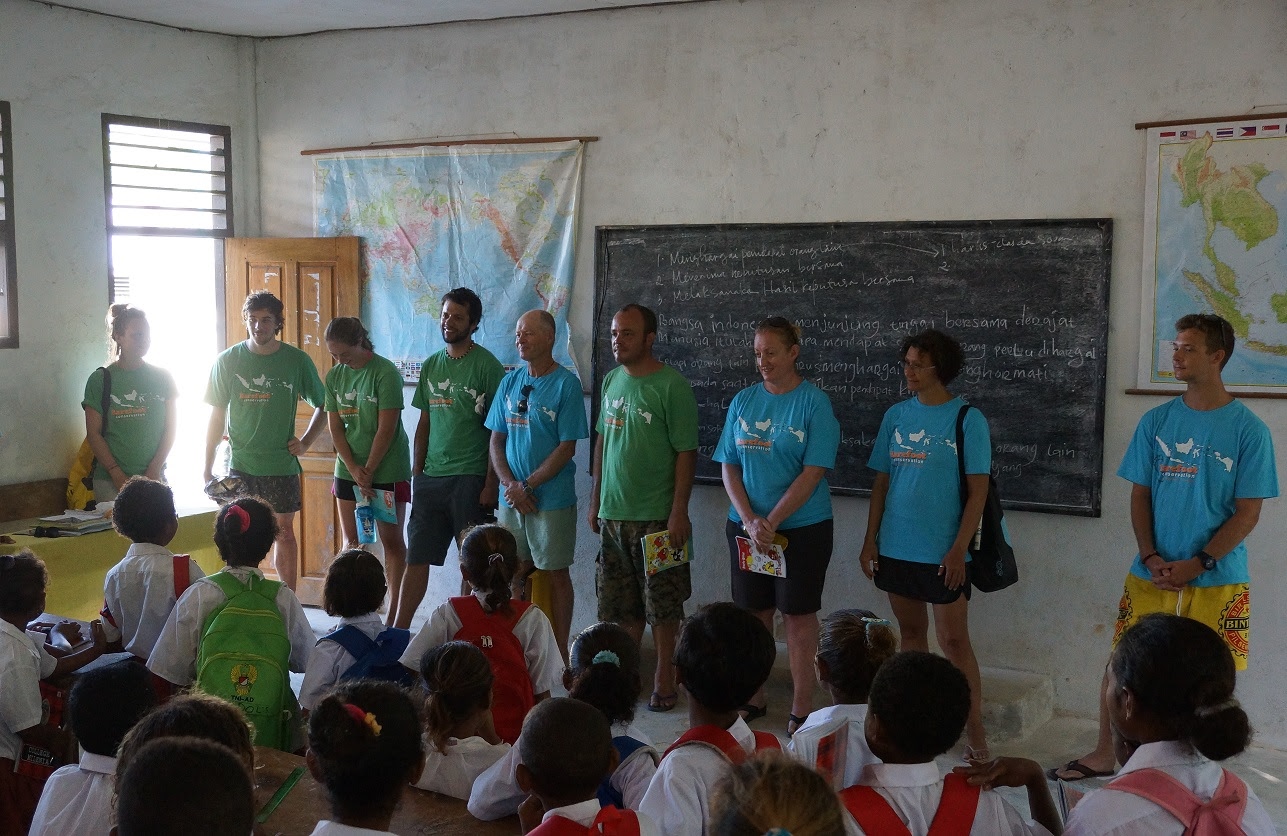
Social Life
Barefoot Conservation is run and owned by ex-expedition volunteers so we understand that volunteering for an expedition is not just about the amazing survey dives and making a real difference in the local community, its also about the friends you make, who, more often than not, become friends for life.
That is why we encourage a good social life while on expeditions; fancy dress parties, murder mystery nights, social events, evening games, movie nights, volley ball competitions and a few cold beers on a Saturday night are all part of that.

Local Cultures & Customs
Barefoot Conservation relies heavily on the relationship between us, the local community and the government of the host country our projects are based in. We are merely guests in their county and, as such, all expedition volunteers and staff must act accordingly. When you join a Barefoot expedition you become part of the larger Barefoot community. You are the face of Barefoot Conservation and hence you must be aware of and respect all local cultures and customs.

All expedition volunteers/staff are briefed by the EL & CM on arrival, regarding the local cultures and customs you need to be aware of and respect while on the expedition. We also recommend you brush up on Indonesian/West Papua local cultures and customs before your expedition. Specific country travel guides or internet searches are a good way to do this.
Equipment
Diving Equipment:
All volunteers joining our expedition as a non-diver or a qualified diver, must bring the follow diving equipment: BCD, Regulator set, mask, wetsuit, fins, dive boots, and a dive computer. Dont worry if you do not have these items or you do not wish to carry them around, while on further travels, as it is possible to rent these items from us. Please see our "costs & dates" page for further details, or contact one of our operations team. *NOTE during busy periods equipment may need to be shared between volunteers/staff.
All volunteers will be provided with tank, weights and weight belt as part of your expedition fee. Other items that volunteers need to bring are a dive slate, torch and reef hook. Please check the equipment list sent to you in your welcome email, for a full list of what to bring.
Personal Expenditure
Over the course of a Barefoot Conservation expedition volunteers will require funds for in-transit expenses and personal expenditure, such as bar refreshments, luxury items from the capital etc. A budget of approx. £185 to cover in-transit expenses to/from the expedition base, and a budget of approx £150 per month for personal expenditure during the course of your expedition is usually adequate. A rough guide to help you plan personal expenditure whilst in-transit to/from the expedition and during the course of their expedition is given below:
The exchange rate for the Indonesian Rupiah (IDR) fluctuates so please check current rates before leaving.
Outgoing Journey Personal Expenditure
- Visa on Arrival - $35 US dollar and $35 for a 30 day extension if needed.
- Any Excess Baggage - 24,500 IDR (approximate)per kilo over the Maximum 20 kilo allowance (20kg for Lion Air, 10kg for Wings Air)
- Taxi Sorong Airport to Hotel - 50,000 to 100,000 IDR
- Taxi Fave Hotel to Ferry port Sorong - Free (included in Expedition Fee if arriving on designated expedition start dates)
- Accommodation Sorong - 500,000 IDR (250,000 IDR each if sharing twin room) (Breakfast included)
- Evening meal - 50,000-100,000 IDR
-
Ferry Sorong to Waisai (Raja Ampat capital) - 150,000 IDR
-
Raja Ampat Marine Park Fee - 1,000,000 IDR
On-site Personal Expenditure
- Personal expenses per month (bar refreshments, luxury items etc..) - 2,000,000 IDR - 3,000,000 IDR
- Visa extensions if needed - 500,000 IDR (per 1 month extension for VOA), 500,000 IDR (for Social visa extensions).
- Extra optional PADI dive courses - Rescue Course £220 - Divemaster course £370
- Any ad-hoc scuba equipment rental not pre-arrange - See "Costs & Dates" for prices
Return Journey Personal Expenditure
- Ferry Waisai to Sorong - 150,000 IDR
- Taxi from port to hotel - 100,000 IDR (can be split between several volunteers)
- Accommodation Sorong- 500,000 IDR (250,000 IDR each if sharing twin room) (Breakfast included)
- Meals - 50,000 - 100,000 IDR
- Taxi hotel to Sorong aiport - 100,000 IDR (can be split between several volunteers)
- Excess Baggage - 24,500 IDR per kilo over the Maximum 20 kilo allowance (15kg for Lion Air, 10kg for Wings Air)
We recommend you bring the majority of your money in Indonesian Rupiah with some US$ Dollars as a backup for emergencies (approx US$100). The best chance to get any money out from an ATM is in Sorong. Waisai does now have some ATM's, however not all international bank cards work. Travelers cheques are not recommended.
Important - While there are new ATM machines in Waisai (where we go every Wednesday for supplies), some foreign ATM cards do not work with them. This means there may not be another opportunity to make further currency exchanges or ATM withdrawals until you return to Sorong at the end of your expedition.
Volunteers should therefore consider carefully how much foreign currency they plan to carry as cash for the duration of their expedition.
Barefoot Conservation also recommends that volunteers bring a credit card for emergency use as many insurance companies will not pay for bills upfront and so initial payments may be needed.
The best way to get to Raja Ampat is from Jakarta the capital of Indonesia. Once you have taken your international flight to Jakarta, you will need to take an internal domestic flight to Sorong on West Papua. This is the closest airport to Raja Ampat and operators that fly there are: Lion Air , Sriwijaya Air, Garuda Air and Batik Air.
Volunteers MUST be in Sorong of the morning of there expedition start date, though we recommend you arrive the day before. The meeting point on the start date of your expedition is the Darefan Hotel close to the airport. The ferry to Waisai the capital of Raja Ampat leaves Sorong at 9am . A Barefoot staff member or representative will collect you at 8am from the lobby of the Darefan hotel and take you to the ferry, with takes approx 2 hours to get to Waisai. Our boat will meet you on arrival in Waisai and take you on the final 40-60 minute boat ride to your home for the duration of your expedition.
Barefoot Conservation can help you with all internal flight bookings, and advise on international flights. Please do not hesitate to contact us when booking both international and domestic flights.
Yes. Most nationalities will need a Visa when entering Indonesia. Please note in most cases a Visa On Arrival (VOA) can be obtained at the airport for US$35 (approximately £25, $50 AUD) or can be purchased in your home country before departure. The VOA is for a total duration of 30 days only and can only be extended once in country, for another 30 days (approximate cost US$60 or £40). If you are joining an expedition for more than 30 days we recommend you purchase a 60 day tourist visa or 60 day social visa from the Indonesian embassy in your country. Please contact one of our helpful trip advisers before applying for this visa, as we can provide you with all necessary forms and information to process the application.
*Please note there is now a FREE 30 day visa on arrival option for most countries. This visa however can NOT be extended when in Indonesia. Please check you local Indonesian embassy to see if your country is on the list.
You will need both scuba diving and travel insurance that covers you for the duration of your expedition and for scuba diving up to 30 meters. IF YOU DO NOT HAVE ADEQUATE SCUBA DIVING INSURANCE YOU WILL NOT BE ALLOWED ON THE EXPEDITION.
We strongly recommend you use Divers Alert Network (DAN) for your insurance as they are by far the best and most reasonably priced. Please visit www.diversalertnetwork.org for further details.
It is important that you consult with your local physician 4-8 weeks before joining the expedition. This is so you can get up to date information on vaccinations and general health concerns when travelling to East Indonesia. In general you will need to make sure the following vaccinations are up to date: Hepatitis A, Hepatitis B, Typhoid, Polio, Japanese Encephalitis, Rabies and Tetanus-Diphtheria.
While the site does not generally have a major issue with mosquito's (due to the beach front location and cool breeze), we still recommend you take precautions against Malaria. However we do not recommend you take Lariam (mefloquine) tablets as these can have side effects that could be mistaken for Decompression Sickness.
In all cases please consult your local physician for up to date medication advice.
The temperature is around 27-30°C all year round. Generally the coastal regions are hot and muggy, but the project site has a nice cool breeze on one side and is protected on the other. The most rain falls between May and September, however most spells are short and never for more than a few days at a time.
One of the beauties of Raja Ampat and our project site is the remoteness and the feeling of getting away from it all. However there is one local mobile phone operator that does have coverage in the region. At present only Telkomsel has reception in our area, so if you really do want to be contacted it is possible to purchase Telkomsel SIM cards and use them in your mobile phones while on site.
There is limited 2G internet access at the basecamp via smart phones. Volunteers have been able to access emails, Skype, Whatsapp, BBM, and even book flights and do online banking, through their smart phones and Waisai now has 3G. Please remember how remote the island is, and that patience is needed when trying to get online.
At the Expedition Leaders discretion it is possible to go to the capital to use the internet on Wednesdays when we are collecting volunteers or supplies.
No mobile phones are permitted during Scuba/Science lectures or while attending any community projects.
The science team at Barefoot Conservation has put together a detailed science program for you to undertake. You will learn key fish families/species, corals, invertebrate and plant life. Our science team will teach you how to identify these, first through classroom presentations and then through in-water spot dives. Following these presentations/dives there will be tests (both classroom and in-water) on each of the above sections.
You will also learn all about Manta Rays and how to monitor them, thanks to the Aquatic Alliance our new partner in our Manta Ray Research Programme.
There will also be advanced science presentations on various subjects for those who wish to attend.
We make your safety our top priority, so for these reasons you will need to pass the scuba diving tests for PADI Open Water and Advance Open Water before we let you go on survey dives.
It is also very important that the data you collect from these survey dives is accurate. This data will be used to show the health of the reef to local government, project partners and the local community. It will also be used to suggest best practices for the community and government, to maintain a healthy coral reef and ecosystem for the future. Therefore you must also pass the relevant science tests to ensure you have the knowledge and skills to collect accurate data.
There will be in-water tests as well as class room ones, on identifying fish families/species, Corals, Inverts and Plant Life.
At Barefoot Conservation we put a lot of focus on working with the community and making them a big part of our work; after all we are only visitors in their home.
Our Community Manager, together with the Community Officer, will work with the local government and community to discuss, create and manage suitable community projects. These are projects where all parties feel your help and money is needed the most. These projects could range from providing clean water, renewable energy, waste management, English lessons and providing medical healthcare/treatments.
You will be involved in providing education to all local communities, about the importance of sustainable non-destructive fishing techniques.
Other major projects you will be involved in are, encouraging entrepreneurship and educating/preparing the communities for ecotourism and globalisation.
Raja Ampat is in the far east of Indonesia, off West Papua. The region is made up of some 617 paradise islands, many of which are still waiting to be discovered and have coral reefs that have NEVER been dived.
Simply drop us a call or email, which you can find on the "contact us" page, and one of our helpful trip adviser's will guide you through what you need to do to reserve your place on the project.
We recommend a minimum of 4-6 weeks to really get the most out of your experience. The scuba diving and science training normally takes between 2-3 weeks, so it is not until the 4th week that you really get your teeth into the survey diving and community work. However, we understand that not everyone can come for this amount of time due to work commitments or other. So we have devised a shorter program for those who are already qualified divers and only have 2-3 weeks available. These places on the project are limited, so make sure you book early. Volunteers can also extend their stay while on the project from week to week. The longer you stay the cheaper it becomes!
Due to logistical reasons the start dates for the projects are set through out the year. We provide scuba diving and science training with in the first 3 weeks, for which all long-term volunteers need to be present. However, if you would like to attend our 2-3 week special shortened program these dates are a little more flexible. Please contact one of our helpful trip advisers for more details. For all expedition dates through out 2013/14 please see our "costs & dates" page.
Please see our "costs & dates" page for exact details on how much it costs to join an expedition and what is/is not included in the expedition fee.
The majority of the money you paid will go to the day to day running of the project you are on, accommodation, food, fuel and local staff wages. A proportion of it will also go to the community projects you're involved in while on the expedition. So your money may help buy new school books for the local children, building materials for the new community center or vaccinations to protect the villagers against many otherwise deadly diseases.
At Barefoot Conservation we are a true believer in transparency. We want you to know that your money is going directly to the people that need it and that you really are making a difference.
While all necessities are provided in the price of the expedition, there are opportunities to purchase the odd luxury like a cold beer or coke to help watch the amazing sunset. The local village also has a small shop where you can buy other goodies like sweets.You may also decide you wish to undertake further scuba diving courses, such as Rescue Diver and Dive Master. Please see the "costs & dates" page for further details on these courses.
Due to safety and logistical reasons it is not always possible for you to come and go from the site when you please (unless for medical or visa extension reasons). However, there may be opportunities to go to the capital Waisai on Wednesdays (90 minutes by speed boat) should a member of staff need to go there. We understand that, when on a remote expedition some mild cabin fever can set in. So, when possible, the expedition staff will try to arrange trips to the capital or off site to other locations. Local boats from the village can also easily be arranged should you need to travel to Waisai on a non Wednesday. Please speak to the on-site staff once on the project regarding this, or members of the local community.
If you decide you no longer wish to stay on the project and leave early, please refer to our cancellation policy in our terms and conditions, using this link, for more information on this.
Go to "General FAQ's" Go to "Diving FAQ's"
Barefoot Conservation asks for an up front £200 deposit which is non-refundable in all circumstances. It is also very important that you read and sign the Booking Conditions when you pay your deposit. This will guarantee you a place on the expedition. Volunteers who cancel 4 weeks or less before the start of the project will not be refunded at all. Volunteers who cancel before this date will be dealt with on a case-by-case basis, but in some circumstances it may be possible to re-book for another date/expedition. In the unlikely event that you are not able to attend an expedition and you have already paid your balance, your travel insurance company should be able to offer you a refund. Please check your policy for more details. Once a volunteer has joined the project, there is no refund option available., should they decide to leave early. Because of our strict cancellation polices, we highly recommend volunteers take out trip cancellation insurance.
Go to "Project FAQ's" Go to "Diving FAQ's"
No previous experience is needed. Dive courses are conducted in the first week of your expedition. You can also take additional PADI dive courses like Rescue and Divemaster whilst on the project. Please see our "costs & dates" page for more details on additional courses.
All volunteers joining our expedition's as a non-diver or a qualified diver, must bring the follow diving equipment: BCD, Regulator set, mask, wetsuit, fins, dive boots, a dive computer, reef hook, torch and delayed SMB. Dont worry if you do not have these items or you do not wish to carry them around, while on further travels, as it is possible for you to rent your BCD, Regulator, Wetsuit, Fins, Mask & Dive Computer from us (we do not have reef hooks, torches or delayed SMBs for rent). Please see our "costs & dates" page for further details, or contact one of our helpful trip advisers.
All volunteers will be provided with a tank, weights and weight belt as part of your expedition fee.
YES - This is extremely important, you will not be allowed on the expedition with out adequate insurance that covers you for diving up to 30 meters and for the duration of your stay. We strongly recommend you use Divers Alert Network (DAN) for your insurance as they are by far the best and most reasonably priced. Please visit www.diversalertnetwork.org for further details.
Raja Ampat has over 80% of the world's hard corals and is one of the most bio-diverse areas in the world due to currents from different oceans flowing into the region. This means that at times there may be small, mild currents on some of the dives. However, you will be fully trained on how to dive in currents and will not be expected to go out on surveys until you are totally confident and have good buoyancy skills. Experienced divers may wish to bring a reef hook, and delayed SMB (though these are also provided on site).
We have some of the best boat drivers in the area. They were born in the local villages and know the curents on dive sites very well. Their local knowledge (some of which has been passed down from generation to generation), is second to none. We also use tide apps on smart phones to determine when it is best to dive a site, to avoid strong currents ie: rising, slack or falling tides.
At Barefoot Conservation safety is our top priority. We have all state of the art medical equipment for remote diving; including oxygen, first aid kits, AED and when possible a Medical Officer on site. The local government installed a new Decompression Chamber in the capital's (Waisai) hospital in 2013. This means the nearest Decompression Chamber to our basecamp is only a 45 minute fast boat ride away.
We require all divers to be qualified to a PADI Advanced Open Water level or equivalent from another organisation. Please see this "comparison table" if your qualification is from another organisation. If you are joining an expedition as a non-diver, your expedition fee includes us training you up to PADI Advanced Open Water and Emergency First Response (EFR - First Aid).
You will typically do 2 dives a day (when possible). Both dives may be done in the morning after breakfast, or both in the afternoon after lunch. This leaves the morning/afternoon available for you to be involved in the community projects and have some downtime. Mon-Fri is reserved for survey dives, while Saturday is for fun dives (recreational), with Sunday being a no dive day (for safety reasons).
We try and do a night dive every 1-2 weeks, this also depends on the tides.
There may be times when it is not possible to do 2 dives a day for example due to extreme weather conditions, equipment issues, village ceremonies, national holidays and other events outside of our control. As we are guests on the island and the local community, we always respect the local communities customs and cultures. We also always put your safety as our top priority, at all times and we will never take unnecessary risks that may jeopardize your health and safety by diving in bad weather/sea conditions!
Please note we make no guarantee of a certain amount of dives per week, and volunteers should be aware they are not joining a dive resort and/or purchasing a dive package.
Yes. There will be opportunities for you to do the PADI Rescue Diver and Dive Master courses while on the project.
If you are starting the expedition as a non-diver and wish to complete the dive master course we recommend you allow yourself at least a 8-12 week expedition to enjoy the full benefits and experience offered by the PADI dive master course.
Please see our "costs & dates" page or contact us today for more details.
Go to "General FAQ's" Go to "Project FAQ's"

Barefoot Conservation's Raja Ampat project site, is situated in the East Indonesian/West Papua region of the coral triangle.

The oceans that surround Raja Ampat contain 80% of all the world's coral species (10 times the number of species found in the entire Caribbean!), 1350 species of fish, 6 of the world's 7 marine turtle species and 27 varieties of marine mammal.
Raja Ampat is in the far east of Indonesian, off of Papua and the region is made up of some 1500 paradise islands, many of which are still waiting to be discovered and have reefs that have NEVER been dived.
Use the below links to quickly navigate to the pages you need:-
RAJA AMPAT EXPEDITION COSTS
Our marine conservation and community projects wouldn't be possible without our volunteers. The expedition fee you contribute provides essential funding, that goes directly to the project you're on. We are committed to making sure you can see where every penny is spent and the difference it makes. Whether you join us for 2 weeks or 20, the energy, passion and commitment of our volunteers is the driving force of Barefoot Conservation.
Please see below for what is and is not included in your expedition fee.
EXPEDITION FEE - RAJA AMPAT
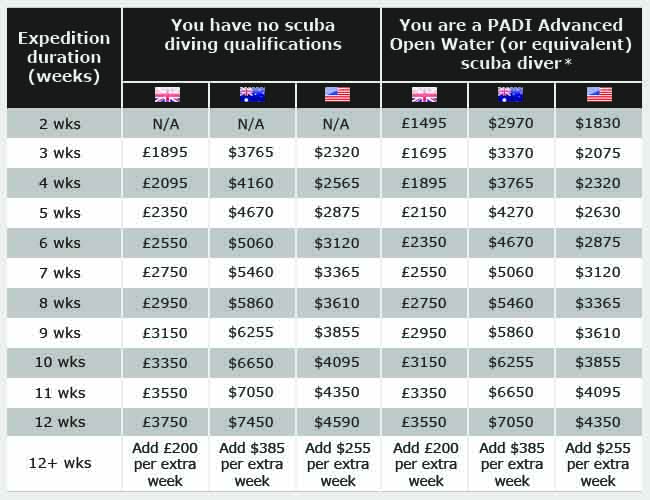
NOTE*THE US AND AUS DOLLAR ($) VALUES IN THE ABOVE TABLE ARE FOR APPROXIMATE INDICATION ONLY, THE UK POUND (£) VALUE IS THE AMOUNT THAT NEEDS TO BE PAID FOR EXPEDITIONS. PLEASE USE WWW.XE.COM TO GET THE UP TO DATE US AND AUS DOLLAR EQUIVALENT VALUES.
* For divers who are PADI Open Water qualified (or equivalent level with other dive organisation), please add another £200 to the expedition fee for the PADI Advanced Course. (fee does not include online eLearning and PADI Certification fee, approximately £95)
Included in the expedition price :
- Departure briefing
- Accommodation on a paradise beach location
- 3 meals a day, including: tea, coffee and filtered water
- All scuba diving training for non-divers (up to Advanced Open Water)
- Tanks, air, weights & weight belts (All divers)
- Comprehensive Science Training Programme
- All survey and recreational (fun) dives (12 a week in total when possible)
- Optional FREE PADI Emergency First Response course worth £100 (volunteers must bring own EFR manual and EFR PIC)
- Taxi from the Sorong pickup location to the ferry port *If arriving on expedition start date only!
- Transfer from Waisai Port to Basecamp
- 24hr field support staff
- All community project involvement
Not Included in the expedition price :
- International and Domestic flights
- In-transit accommodation
- Ferry costs from Sorong to Waisai and Waisai to Sorong
- Visas
- Raja Ampat Tourism Ticket (1,000,000 IDR, to be paid on arrival in Waisai)
- Raja Ampat Marine Reserve park fee (700,000 IDR. This can be paid online in advance via this website:
- Travel & Diving insurance
- PADI manuals and Dive Certification (Positive Identification Card-PIC or eLearning)
- Personal diving equipment (see our Project Guide for details)
- Additional dive courses (Rescue and Divemaster courses, including the manuals, eLearning, Crew Packs, PADI certification fees, DM application fee)
- Any personal spending money
Please see the Personal Expenditure section of our Project Guide to get an approximate idea of how much each of the above "Not Included" items will cost.
Optional extra costs :
Extra PADI Courses
There will be opportunities for you to do the PADI EFR, Rescue Diver* and Divemaster** courses while on the project. The costs of these courses (excluding online eLearning and PADI certification fee, approximately £95, depending on the course) are :
EFR Course - FREE (however volunteers must purchase their own EFR online eLearning that comes with PADI certification)
Rescue Course* - £220
Divemaster Course**- £370
Prices are in pound sterling
*In order to complete the PADI Rescue course is it mandatory for the student to have completed the PADI EFR course. This course (worth £100) is offered FREE of charge, however the volunteer must purchase the online EFR eLearning that comes with PADI certification.
**If you are starting the expedition as a non-diver and wish to complete the Dive Master (DM) course we recommend you allow yourself at least a 12 week expedition to enjoy the full benefits and experience offered by the PADI dive master course. However if you are already a PADI AOW diver, the DM course can be done in 7-8 weeks. Please contact us if you have any questions regarding the Divemaster course.
The above course prices do not include the PADI manuals/eLearning or PADI certification Fees), which PADI have now made mandatory to purchase for all courses. The volunteer MUST bring with them the necessary PADI manuals for the course they wish to undertake or purchase the online eLearning.
The approximate prices of the PADI online eLearning (with PADI certification fee) are below:-
- Open Water course - online eLearning - £95
- Advanced Open Water course - online eLearning - £95
- Emergency First Response course - online eLearning - £50
- Rescue Diver course - online eLearning - £95
- Divemaster crew pack - online eLearning - £260 (price may vary depending on courier costs)
PADI now prefers students to use there online eLearning system, rather than buying the paper manuals. Please contact us directly for eLearning prices for each course you wish to take with us.
Scuba Equipment Rental
Volunteers need to bring with them the following dive equipment items: BCD, Regulator set, mask, wetsuit, fins, dive boots, reef hook, dive torch, delayed SMB, dive slate and dive computer. It is however possible to rent some of these items on site, if you do not wish to carry them while on further travels. Rental items may need to be shared between volunteers during busy periods.
*The below rental costs are for the volunteer marine conservation expeditions only. The Liveaboard trips have different rental costs.*
The following items are available for rental on-site (costs are per week and in Pounds Sterling £) :
- Buoyancy Control Device (BCD) - £15
- Full regulator set (1st, 2nd stage, Octopus and SPG) - £15
- Mask & Snorkel - £10
- Wetsuit (Shortie 3mm) - £10
- Fins & Dive boots - £15
- Dive Computer* - £20 (£150 refundable deposit (if dive computer returned in same working state) needed)
* For safety reasons, it is now mandatory for all Barefoot Conservation divers to use a dive computer on all dives. If you do not own one, you will need to rent one from us.
If you would like to rent any of the above items for your expedition, please indicate this on your booking form or inform one of our trip advisers, before you go. If you do not do this, we can not guarantee the items you may need, will be available when you arrive on your expedition.
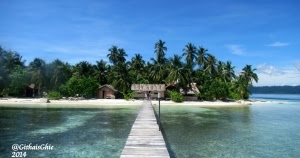
Our accommodation on Arborek island, Raja Ampat.

These amazingly clear waters make visibility when diving perfect, allowing you to never miss a thing.

Raja Ampat may well be diving's final frontier, this stunning tropical paradise has the highest known concentration and diversity of marine life on earth.

Barefoot Conservation is a not-for-profit organisation that takes a fresh look at marine conversation and community awareness. All of the Barefoot staff share the same passion for making a real difference at a grass root level, on all our projects.
If you would like to join us in trying to make a real difference to peoples life's, share our passion and outlook, then please check out our current vacancies below.
Barefoot Conservation endeavors to respond to every single application, however due to high numbers of applicants, this may not always be possible. Barefoot Conservation is an equal opportunities employer, and all applications will be treated fairly and equal.
We place all our vacancies on our preferred recruitment agencies environmentjobs.com and wiseoceans.com
Sustainability . Conservation . Ethics

The accommodation on the Barefoot Conservation's Raja Ampat expedition is situated in the perfect paradise beach location, footsteps away from the unrivaled coral reefs.
RAJA AMPAT EXPEDITION DATES
Barefoot Conservation expeditions run through out the year and start every four weeks. Please note the different start dates for dive trainee's and qualified divers.
2026 EXPEDITION DATES
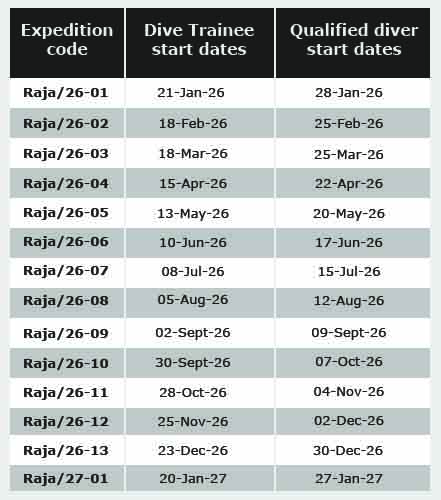
We limit the amount of spaces on each expedition so volunteers can get the best possible experience and one-on-one time with out Marine Biologists and Community teams. So make sure you book early to avoid disappointment.
2027 EXPEDITION DATES

We limit the amount of spaces on each expedition so volunteers can get the best possible experience and one-on-one time with out Marine Biologists and Community teams. So make sure you book early to avoid disappointment.

Bali - IndonesiaThis well known 'Island of the Gods' has amazing beaches, lush rice terraces, volcano's and world class diving

Raja Ampat 3 - IndoneisaComing Soon.....At Barefoot Conservation we are always researching new project sites, so watch this space for new locations.

Raja Ampat 2 - IndonesiaAt Barefoot Conservation we are researching new project sites within the 617 islands of Raja Ampat. So watch this space.

Raja Ampat - IndonesiaThis region is one of the last diving frontiers in the world and with 80% of the worlds corals it is not to be missed.
Quisque egestas consequat mi. Aenean orci mauris, viverra sit amet tincidunt eget, facilisis id ligula. Curabitur sollicitudin ornare justo vel pretium. Pellentesque adipiscing suscipit neque at pretium.


Nunc ornare semper quam vel varius. Curabitur at nibh dolor, quis interdum nunc. Duis aliquam accumsan pulvinar. Nulla vel purus mauris. Phasellus vel orci quam. Nullam sodales libero a neque luctus at rutrum orci consequat. Nunc viverra mauris sed justo iaculis venenatis. Mauris nec suscipit orci.
Nunc ornare semper quam vel varius. Curabitur at nibh dolor, quis interdum nunc. Duis aliquam accumsan pulvinar. Nulla vel purus mauris. Phasellus vel orci quam. Nullam sodales libero a neque luctus at rutrum orci consequat. Nunc viverra mauris sed justo iaculis venenatis. Mauris nec suscipit orci.
Nunc ornare semper quam vel varius. Curabitur at nibh dolor, quis interdum nunc. Duis aliquam accumsan pulvinar. Nulla vel purus mauris. Phasellus vel orci quam. Nullam sodales libero a neque luctus at rutrum orci consequat. Nunc viverra mauris sed justo iaculis venenatis. Mauris nec suscipit orci.

Raja Ampat's crystal clear waters contain 80% of the worlds corals, larvae produced here are swept across the oceans to replenish other reef ecosystems.

The oceans that surround Raja Ampat contain 80% of all the world's coral species (10 times the number of species found in the entire Caribbean!), 1350 species of fish, 6 of the world's 7 marine turtle species and 27 varieties of marine mammal.

The perfect clear beaches and calm lagoon's of Raja Ampat provide a haven for both land and sea juveniles.
Access to, and use of, the Barefoot Conservation website at www.barefootconservation.org ("the Website") is provided by Barefoot Conservation and is subject to the following Terms and Conditions of Use:
- The Website is operated by Barefoot Conservation Limited (company registration number 8237883) whose registered office is at 63 Portland Avenue, Gravesend, Kent, DA12 5HJ and the Barefoot Group of companies.
- Use of this Website constitutes your acceptance of these Terms and Conditions of Use, which take effect immediately on your first use of the Website. Barefoot Conservation reserves the right to change these Terms and Conditions of Use at any time by posting changes on the Website and you accept that you are bound by the Terms and Conditions of Use in force at that time and displayed on this page. If these Terms and Conditions of Use are not accepted in full, you do not have permission to access the contents of this Website and therefore should cease using this Website immediately.
- All rights in the Website (including copyright, the content and design of the Website) is owned by Barefoot Conservation or used under licence from third parties. Material from the Website may not be copied, reproduced, republished, downloaded, posted, broadcast, transmitted or re-transmitted in any way, distributed, sold or displayed, in any medium, except for your own personal non-commercial use, without the express written permission of Barefoot Conservation or in accordance with the Copyright, Designs and Patents Act 1988. Any other use requires the prior written permission of Barefoot Conservation. You agree not to adapt, alter or create a derivative work from any of the material contained on this Website or use it for any other purpose other than for your personal non-commercial use. You can download and use the service on a single CPU at a time and you can print out a single hard copy of any part of the content on the Barefoot Conservation website for your personal use.
- You agree to use this Website only for lawful purposes, and in a manner that does not infringe the rights of, or restrict or inhibit the use and enjoyment of this Website by any third party or other users. This includes, without limitation, conduct which is unlawful, or which may harass or cause distress or inconvenience to any person and the transmission of obscene, offensive, defamatory, pornographic, racist, threatening or political content or do anything to disrupt the normal flow of dialogue within this Website.
- This Website and the information, names, images, pictures, logos and icons regarding or relating to Barefoot Conservation its products and services (or to third party products and services), is provided "AS IS" and on an "IS AVAILABLE" basis without any representation or endorsement made and without warranty of any kind, whether express or implied, including but not limited to the implied warranties of satisfactory quality, fitness for a particular purpose, non-infringement, compatibility, security and accuracy. To the maximum extent permitted by law, Barefoot Conservation shall not be liable for any damages including, without limitation, indirect or consequential damages, or any damages whatsoever arising from use or loss of use, data, or profits, whether in action of contract, negligence or other tortuous action, arising out of or in connection with the use of the Website. This does not affect you statutory rights under English law.
- Any destination/travel guide or information provided on the Website is written purely for information purposes. Although Barefoot Conservation endeavors to ensure that such information is accurate, Barefoot Conservation provides no guarantee that such information is accurate and is provided solely as additional background content. Barefoot Conservation shall not be held liable in any way whatsoever for any inaccuracy, misunderstanding or expectation drawn from this content. Barefoot Conservation shall also not be liable if any of the expeditions detailed on the Website are not available and details of expeditions, including departure dates, prices, etc, will be as confirmed by Barefoot Conservation at the time of booking your arrangements. Barefoot Conservation aims to update the Website regularly and may change content at any time and without notice. Barefoot Conservation shall not be liable if the Website is not available at any time or for any period.
- Barefoot Conservation does not warrant that the functions contained in the material contained in this Website will be uninterrupted or error free, that defects will be corrected, or that this Website or the server that makes it available are free of viruses or bugs or represents the full functionality, accuracy, and reliability of the materials. You must not misuse the Website by introducing viruses, Trojans, worms, logic bombs or other material which is malicious or technologically harmful. You must not attempt to gain unauthorised access to the Website, the server on which the Website is stored or any server, computer or database connected to the Website.
- The names, images and logos identifying Barefoot Conservation or third parties and their products and services are proprietary marks of Barefoot Conservation and/or third parties. Nothing contained herein shall be construed as conferring any license or right under any trade mark or other intellectual property right of Barefoot Conservation, or any other third party.
- Any material you upload or submit to this Website (including without limitation any text, graphics, video or audio) will be considered to be non-confidential and non-proprietary and Barefoot Conservation shall be automatically granted permission to freely use, reproduce, modify, adapt, publish, translate, create derivative works from, distribute, perform, play, transmit and exercise all copyright and publicity rights with respect to any such work worldwide and/or to incorporate it in other works in any media now known or later developed, for the full term of any rights that may exist in such content, consistent with privacy restrictions set out in the Barefoot Conservation Privacy Policy. If you do not wish to grant such rights to Barefoot Conservation it is suggested that you do not submit your contribution to this Website. By submitting your contribution to this Website, you also:
- Warrant that such contribution is your own original work and that you have the right to make it available to Barefoot Conservation for all the purposes specified above;
- Indemnify Barefoot Conservation against all legal fees, damages and other expenses that may be incurred by Barefoot Conservation as a result of your breach of the above warranty; and
- Agree to waive any moral rights in your contribution for the purposes of its submission to and publication on the Barefoot Conservation site and the other purposes specified above.
- If there is any conflict between these Terms and Conditions of Use and/or specific terms appearing elsewhere on this Website relating to specific material, then the latter shall prevail.
- Barefoot Conservation is not responsible for the content of the external sites linked to from this Website. Any links provided on the Website to other websites are not intended to provide an endorsement by Barefoot Conservation (unless otherwise specified) and Barefoot Conservation will have no liability or responsibility for the content of this or those websites whatsoever. You must not establish a link to this Website from any other website without Barefoot Conservation's explicit prior written consent.
- You are responsible for making all arrangements necessary for you to have access to the Website and for ensuring that all persons who access the Website through your internet connection are aware of these Terms and Conditions of Use and that they comply with them. If you, or anyone accessing the Website through your Internet connectivity, breach these Terms and Conditions of Use, Barefoot Conservation shall be entitled to suspend or permanently terminate your access to the Website.
- If any of these Terms and Conditions of Use should be determined to be illegal, invalid or otherwise unenforceable by reason of the laws of any state or country in which these Terms and Conditions of Use are intended to be effective, then to the extent and within the jurisdiction which that Term or Condition is illegal, invalid or unenforceable, it shall be severed and deleted from these Terms and Conditions of Use and the remaining terms and conditions shall survive, remain in full force and effect and continue to be binding and enforceable.
- It is not the intention of the parties to confer any rights on any third parties by virtue of these Terms and Conditions of Use and accordingly the Contracts (Rights of Third Parties) Act 1999 shall not apply to these Terms and Conditions of Use.
- Barefoot Conservation processes information about you in accordance with the Privacy Policy displayed on the Website from time to time. By using the Website, you consent to such processing and you warrant that all data provided by you is accurate.
- These Terms and Conditions shall be governed by and construed in accordance with the laws of England and Wales. Disputes arising here from shall be exclusively subject to the jurisdiction of the courts of England and Wales.
Privacy Policy
Please find below the Privacy Policy of Barefoot Conservation Ltd, whose registered office is at 63 Portland Avenue, Gravesend, Kent, DA12 5HJ; (registered company number 8237883). The Privacy Policy below details how Barefoot Conservation will treat your personal data after it has been collected by Barefoot Conservation. Barefoot Conservation assures that it will only use your data as specified here and for its legitimate business reasons.
Collection and use of data
- Unless otherwise provided in the Privacy Policy or the Terms and Conditions of Use, Barefoot Conservation will not sell, rent or trade your personal information to third parties for marketing purposes without your express written consent. Barefoot Conservation will only pass your data to other third parties and companies within the Barefoot group in accordance with this Privacy Policy, the Terms of Use and the Booking Conditions, or if required to do so by law. Barefoot Conservation may disclose your data to certain permitted third parties, such as third party service providers, expedition leaders dealing with trips, Barefoot Conservation's own professional advisers who are bound by confidentiality codes and when Barefoot Conservation is legally obliged to disclose your data.
- Barefoot Conservation can obtain personal data from you (including your name, postal address, telephone number, email and your credit/debit card details in order to make payment and confirm the booking) from a number of different sources:
- When you search for or request details on services or expeditions from the Website, or if you supply us with your details when discussing matters over the telephone to us, or if you submit a request for details to be provided to you by mail or email.
- When you complete and submit an application to Barefoot Conservation to take part in expeditions, together with any applicable methods of payment.
- Via your individual IP location. This is a function of the Website that enables Barefoot Conservation to return details of holidays or tours that you have requested, and in order for Barefoot Conservation to diagnose problems with its server and to administer the Website.
- Barefoot Conservation needs your name, address and/or email address so that it can send out information to you and advise you of special offers and promotions it thinks may be of interest to you. Barefoot Conservation also requires this information about you in order to complete your application for expeditions and deal with any bookings on your behalf and in relation to the different services operated by the companies within the Barefoot group.
- In order to complete your booking, Barefoot Conservation will also need to collect information about you, and others included in your group, to pass to third parties (eg, relevant accommodation providers, excursion operators, etc.) for the purposes of booking your expedition. This may involve the transfer of information outside the European Economic Area ("EEA") and by providing Barefoot Conservation with this information you provide your consent (and the consent of those included in your group) to transfer such information out of the EEA. The information collected may include, but is not exclusively limited to, details such as your name, your address (in order to send the relevant documentation relating to your expedition to you), your email address and telephone number (if Barefoot Conservation needs to contact you about your arrangements urgently).
- You have the right to ask Barefoot Conservation not to process your personal data for marketing purposes. You also have the right to access information held about you by Barefoot Conservation, Your right to access can be exercised in accordance with the Data Protection Act 1998, as amended from time to time, and any access request may be subject to a fee of £10 to meet Barefoot Conservation's costs in providing you with details on the personal data we hold about you.
- Barefoot Conservation may obtain information about your general internet usage by using a cookie file which is stored on the hard drive of your computer. Cookies contain information that is transferred to your computer's hard drive. They help us to improve our site and to deliver a better and more personalised service. They enable us:
- To estimate our audience size and usage pattern.
- To store information about your preferences, and so allow us to customise our website according to your individual interests.
- To speed up your searches.
- To recognise you when you return to our website.
You may refuse to accept cookies by activating the setting on your browser which allows you to refuse the setting of cookies. However, if you select this setting you may be unable to access certain parts of our website. Unless you have adjusted your browser setting so that it will refuse cookies, our system will issue cookies when you log on to our website.
- Barefoot Conservation operates in accordance with the Data Protection Act 1998, and any amendments thereto.
Consent
By disclosing your personal information via the Website, over the telephone or via email or post you consent to the collection, storage and processing of your personal information by Barefoot Conservation in the manner set out in this Privacy Policy, the Terms of Use Policy and the Booking Conditions.
'Unsubscribe' Policy
You may at any time unsubscribe to receiving information from Barefoot Conservation by sending an email to
Change/Modify Details
If you change your contact details, please send an email with your new details to
Contact
If you have any questions or concerns about the information Barefoot Conservation holds about you, you may email Barefoot Conservation. Alternatively, you may write to Barefoot Conservation at: Barefoot Conservation Limited, 63 Portland Avenue, Gravesend, DA12 5HJ.
Simply drop us a call or email which you can find on the "Contact us" page and one of our helpful trip adviser's will guide you through what you need to do to reserve your place on the project.
The majority of volunteers stay between 6 and 12 weeks, and we recommend a minimum of 4-6 weeks to really get the most out of your experience. The scuba diving and science training normally takes between 2-3 weeks so it is not until the 4th week that you really get your teeth into the survey diving and community work. However we understand that not everyone can come for this amount of time due to work commitments or other. So we have devised a shorter program for those who are already qualified divers and only have 2-3 weeks available, though these places on the project are limited, so make sure you book early. Volunteers can also extend their stay while on the project from week to week, and the longer you stay the cheaper it becomes.
Due to logistical reasons the start dates for the projects are set through out the year, this is because we provide scuba and science training with-in the first 3 weeks so need all long term volunteers present for this training. However if you would like to attend our 2-3 week special shorten program these dates are a little more flexible so please call one of our helpful trip advisers for more details. For all expeditions dates through out 2013 please see our "expedition dates" page.
Please see our "price & costs" page for exact details on how much it costs to join an expedition.
Included in the expedition price is all scuba diving training (up to Advanced Open Water + EFR) and comprehensive science training. 2 dives and 3 meals a day, tea, coffee and water, accommodation on a paradise beach location. For volunteers signing up as a non-diver, a BCD and Regulator will be provided for FREE during your open water course training. Other items you will need to bring or rent from Barefoot Conservation are:- mask, snorkel, wetsuit, fins, dive boots, dive slate and dive computer
While all necessities are provided in the price of the expedition, there are opportunities to purchase the odd luxury like a cold beer or coke to help watch the amazing sunset. The local village also has a small shop where you can buy other goodies like sweets. Other extra spending money can be spent on further scuba diving courses, like Rescue Diver and Dive Master, please see the "price & costs" page for further details on these courses.
Having done a marine conservation expedition in the past I am very excited that I will be joining this project and get to dive in such a natural and culturally diverse area of the world.
Barefoot Conservation is leading conservation efforts in one of the Earth's last pristine marine environments, by working not only to assess biodiversity value of the ecosystems but also working with local communities to raise awareness and capacities to ensure the sustainable use of natural resources into the future.
Barefoot Conservation will offer me the opportunity to dive some of the most pristine waters in the world, whilst contributing to the marine environment's conservation...bring on my expedition!!
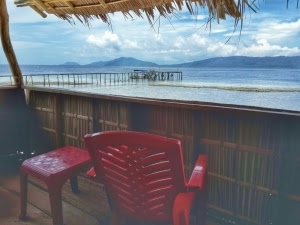
View from the balcony of our new beach bungalow for private room rental.

Coral reefs just don't get more pristine than the ones on our house reef, just meters from your accommodation.

Well stocked with local sweets and treats for when you need a sugar fix!

This iconic creature is at the top of every divers wish list.

Yanbuba is one of the villages Barefoot Conservation volunteers help teach English at.
Please check out the list below, for just a few of the advantages your receive when joining an expedition with us...
A few words about us....
Barefoot Conservation is a new and exciting, not-for-profit organisation that takes a fresh look at marine conservation and community awareness.
Our focus is grass roots conservation and community action. Our aim is to engage, educate and empower the local community to make sustainable conservation a way of life, not just a project.
We feel this holistic approach to conservation will give you/us a greater depth of experience and understanding. Through community projects we gain vital insights into the needs and values of the community and how marine conservation efforts can be integrated to benefit local people.
Our conservation strategy is to help the local community build their resilience to climate change, globalization, and the economic and ecological choices the region will inevitably face.
A major part of our scientific work is our marine research program. This will monitor and assess the impact of climate change, over-fishing, and pollution on the marine environment and the people whose livelihoods depend on it. The information we gather will be used by the local government, local stakeholders, community and NGO's to implement measures to prevent and mitigate ecosystem degradation.
Regions we work in:-

What sets us apart from similar non-profit dive volunteer organisations (other than the stunning pristine untouched paradise location!) is that volunteers see exactly where their contribution to the community is going, and the ratio of your fee that goes into the community is very high. The part of your expedition fee that doesn’t cover diving, insurance, food, accommodation, transport, fuel and minimal staff wages (most of our staff, even the CEO, work for free!) will be spent on community projects. For example, this money may go towards special solar panels that provide clean drinking water for the community and you will help the villagers install them. Or your money combined with others may buy new school books or medicines which are vital for education and health in the communities. You will then help distributing these in the schools/villages and be able to stay in touch with the children you have helped educate.
Some of the money will go toward wider community based projects like installing rubbish bins around the island to keep plastics out of the ocean, but it won’t go to support a fancy head office far away and it certainly won’t be making anybody rich.
Our community projects work to alleviate poverty and create entrepreneurial solutions to ensure conservation is a viable and attractive economic alternative to current practices such as shark finning and/or dynamite fishing. By raising awareness of, and helping implement, strong ecotourism and sustainable fisheries management, we can ensure that the community and visitors benefit from the remarkable marine resources for generations to come.
Under our Indonesian Universities Scholarship Programme, we invite Indonesia's future marine biologists to work and study with us for free. This provides a wonderful opportunity for synergy between international volunteers and Indonesian students, sharing ideas and building a cohesive environmental ethic for the future.
Make a difference. See a difference. Be the difference.
Why become a marine conservation volunteer?
Do you want to have a career in marine biology or conservation? Do you want to do something life enriching with your GAP year or career break? Are you a scuba diver who wants to take your passion to the next level?
With Barefoot Conservation (Yayasan Konservasi Jejak Kaki) you will gain practical marine conservation experience in one of the world’s most stunningly pristine and remote locations for marine research.
- Work with experienced marine scientists and the local community on vital marine conservation projects.
- Learn marine biology field skills essential for scientific and marine conservation research.
- Get involved in local community projects.
- Gain recognized scuba diving qualifications, skills and experience.
Volunteering is one of the most rewarding things you will ever do. Barefoot Conservation (Yayasan Konservasi Jejak Kaki) is committed to ensuring you know the real difference your time with us makes.
Make a difference. See a difference. Be the difference.
" When you walk with naked feet, how can you forget the earth "
- Carl Jung
"Raja Ampat may well be one of diving's final frontiers."
The archipelago known as Raja Ampat, or Four Kings, is made up of over 1500 small islands and cays, although only 35 of them are inhabited including the four main islands, or ‘Kings’, of Misool, Salawati, Batanta, and Waigeo.
Raja Ampat’s unique position on the cusp of two oceans; the Indian and Pacific, is to thank for the areas incredible biodiversity. Powerful deep-sea currents sweep nutrients into Raja Ampat’s eager reefs, the life source for it’s booming populations. The same currents carry the regions larvae across the oceans to repopulate reefs in other parts of the ocean. This area’s importance to marine conservation extends far beyond its tropical borders.
The marine environment alone is enough to enthrall visitors indefinitely, but Raja Ampat has even more to offer than world-class underwater delights. To visit Raja Ampat is to step into a tropical paradise straight from a travel enthusiasts dream. As yet relatively undisturbed, Raja Ampat’s scenery is breathtaking. Crystal clear waters lap the perfect white sand of secluded beaches, lush green rainforest vegetation rises from dramatic limestone cliffs.
The local communities welcome visitors as new friends. Always keen to chat, laugh, invite you to their homes and make you tea whilst the children show off their somersaults into the sea. The traditional Papuan warmth makes you feel at home from the moment you arrive.
This stunning tropical paradise has the highest known concentration and diversity of marine life on earth. Located in the East Indonesia/West Papua region of the coral triangle, Raja Ampat is a top global priority for marine conservation.
The extent of its importance to marine science and ecology is only just being discovered. Incredibly, the oceans that surround Raja Ampat contain 80% of all the world's coral species (10 times the number of species found in the entire Caribbean!), 1350 species of fish, 6 of the world's 7 marine turtle species and 27 varieties of marine mammal.
In the perfect marine metropolis whale sharks breed, manta rays frolic, sperm whales feed, turtles lay eggs and tropical fish dance before you.
This staggering concentration of biodiversity is unparalleled anywhere in the world today. The reefs at Raja Ampat show remarkable resistance to global marine threats such as climate change, coral bleaching and disease. Larvae produced here are swept across the oceans to replenish other reefs which support healthy ecosystems globally and sustainable subsistence fishing for poor local villagers.
What happens in Raja Ampat will have a direct impact on the world's marine ecosystem. It is vital we understand and protect it.
Join us in making a difference today!